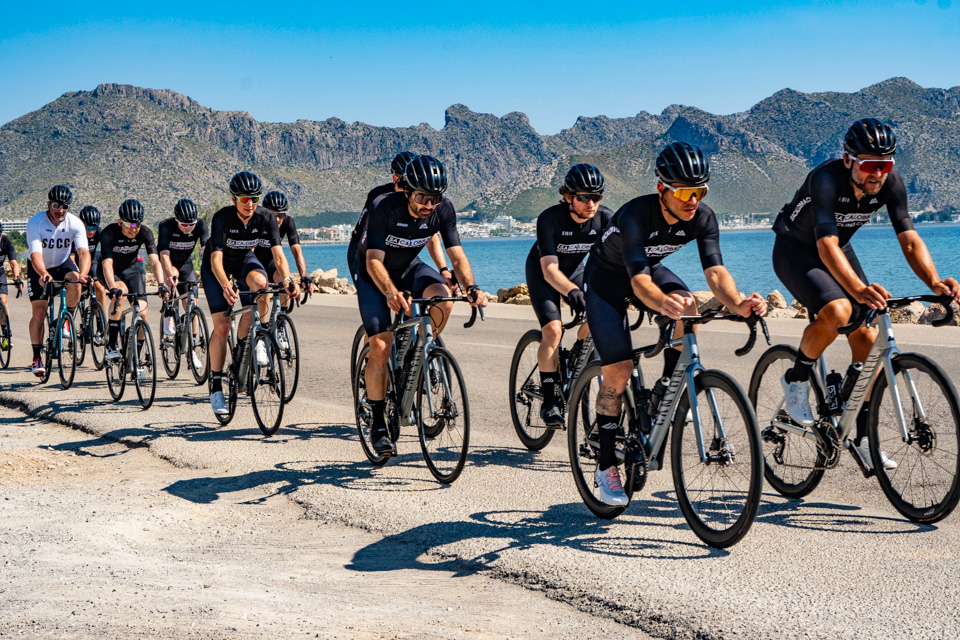
How fit for a cycling camp in Mallorca?
One of the questions we receive most often is simple: “Am I fit enough to join a cycling camp in Mallorca?” And it is an important question.
Mallorca is one of the best cycling destinations in Europe, but riding here can mean very different things. A relaxed coffee ride along the coast is not the same experience as riding Sa Calobra, Puig Major or several mountain passes on consecutive days.
At Sa Calobra Cycling Club, our camps are designed as training camps, not cycling holidays. You do not need to be a professional cyclist. You do not need to race. You do not need to be the strongest rider in your local club. But you do need to train.
What fitness level do we recommend?
As a general guideline, riders joining one of our camps should be around 2.8 to 2.9 watts per kilogram or above. For example:
- A 60 kg rider at 2.9 W/kg has an FTP of approximately 174 watts.
- A 70 kg rider at 2.9 W/kg has an FTP of approximately 203 watts.
- An 80 kg rider at 2.9 W/kg has an FTP of approximately 232 watts.
- A 90 kg rider at 2.9 W/kg has an FTP of approximately 261 watts.
But FTP is only part of the story. We would much rather have a rider with good endurance, sensible pacing and experience riding long days than someone with an impressive FTP who has never ridden for four hours non-stop.
Your FTP doesn't tell us everything
Cyclists love numbers. FTP is useful because it gives us a rough indication of your level, but it cannot tell us whether you are ready for an entire week of cycling. During a camp, the challenge is not simply producing power for twenty minutes. It is being able to ride for several hours, climb repeatedly, recover, eat and drink properly, descend safely, wake up the following morning and do it again. That is very different from completing one hard interval session at home.
This is why, when riders ask whether they are strong enough to join us, we are interested in more than just their FTP. We want to know:
- How often do you ride?
- How many hours do you normally train each week?
- What is your longest ride?
- Are you comfortable riding four or five hours?
- Have you ridden consecutive long days before?
- Are you used to climbing?
- Can you pace yourself rather than attacking every hill?
- Can you eat and drink properly while riding?
Those answers often tell us more than one number.
You need endurance, not just power
A cycling camp creates a type of fatigue that many riders do not experience during a normal week at home. You might feel fantastic on Day 1. You might still feel great on Day 2. By Day 4, however, your legs remember everything you have done earlier in the week. That cumulative fatigue is part of the experience.
Our routes are designed to challenge riders throughout the camp. There are long climbs, sustained efforts and days where managing your energy is just as important as producing watts.
That means preparation should include longer rides and back-to-back training days, not only short high-intensity sessions.
If your normal training week consists of three one-hour indoor sessions, jumping immediately into several days of mountain riding will be difficult, regardless of your FTP.
Do you need to be a racer?
Absolutely not. Many of our riders do not race. They are amateur cyclists who enjoy training, want to improve and want to discover what they are capable of in a professional environment. What matters much more is your attitude toward cycling.
If your idea of a cycling trip is stopping every hour, taking photographs, having a long lunch and cruising back to the hotel, there are excellent cycling holidays in Mallorca designed for exactly that. SCCC is different.
We ride with a purpose. There is still time to enjoy Mallorca, have coffee, laugh with the group and appreciate some of the best roads in Europe. But when it is time to train, we train.
How hard is the climbing in Mallorca?
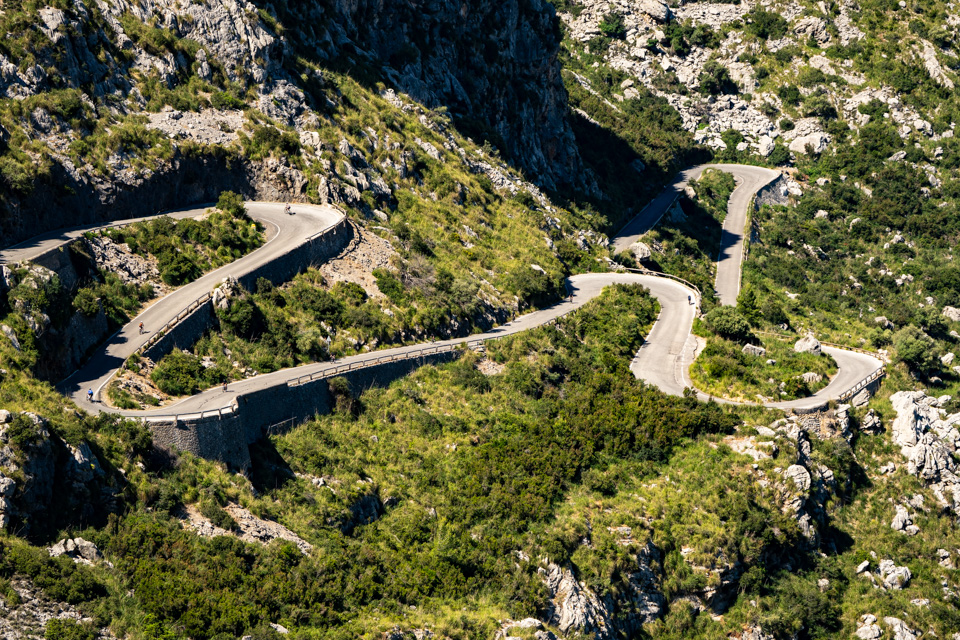
Mallorca does not have the altitude or enormous twenty-kilometre climbs of the French Alps, but that does not make it easy. The Serra de Tramuntana offers repeated climbs, technical descents and constantly changing terrain. Among the climbs riders may experience during the week are Sa Calobra, Puig Major, Sa Batalla, Randa, San Salvador and Formentor. A single climb is manageable for many cyclists. The challenge is putting everything together across an entire week.
One day of climbing is very different from climbing after several days of accumulated fatigue. That is why pacing is so important.
The biggest mistake: riding too hard too early
This is something we see regularly. A rider arrives excited, feels strong and wants to prove it immediately.
Every small climb becomes an effort.
Every wheel has to be followed.
Every acceleration has to be answered.
Three days later, the same rider is wondering where their legs have gone. A cycling camp rewards riders who understand their body. One of the things we try to teach throughout the week is how to use your power meter, heart rate and sensations to ride in control. Sometimes riding five percent easier today means being twenty percent stronger tomorrow.
And when the big day arrives, you want something left in the tank.
You also need to know how to eat and drink
Fitness alone will not save you if you do not fuel properly. Long mountain rides require carbohydrates, fluids and electrolytes. Waiting until you are hungry is too late. Waiting until you are thirsty is usually too late as well.
Learning to fuel while riding is therefore something we recommend practising before arriving in Mallorca. Your stomach needs training just like your legs. A rider who produces slightly less power but fuels consistently will often finish a long stage much stronger than a more powerful rider who forgets to eat.
What happens if I struggle?
Our objective is to challenge you, not destroy you. The group is supported throughout the week and we have a support vehicle available. If somebody has a difficult day, becomes excessively fatigued or simply does not have the legs to complete the route safely, there is always a solution.
There is no trophy for completely emptying yourself on Tuesday and being unable to ride on Wednesday. Knowing when to stop can sometimes be the smartest decision you make during the week. At the same time, riders should arrive having prepared properly.
The support vehicle is there for situations when it is needed. It should not be the training plan.What should you be able to do before arriving?
You do not need to recreate an SCCC camp at home. But before travelling to Mallorca, we would ideally like you to be comfortable with:
- Regular training
- Cycling several times each week rather than relying on occasional weekend rides.
- Long rides
- Being comfortable spending three to four hours or more on the bike.
- Consecutive days
- Completing harder training on Saturday and still being capable of riding on Sunday.
- Sustained efforts
-Being comfortable riding continuously around tempo and threshold rather than only doing short explosive efforts.
- Fueling
- Eating and drinking regularly while riding.
- Descending
You do not need to descend like a professional, but you should be comfortable controlling your bicycle on mountain roads.
What if you are in your 50's, 60's or older?
Age alone is not the deciding factor. We have seen riders continue improving well into their 60s. What matters is preparation, consistency and understanding your capabilities. An experienced 65-year-old cyclist who trains regularly can be considerably better prepared for a camp than a 35-year-old who rides occasionally.
Cycling is one of the rare sports where experience, pacing and endurance can compensate for a lot. And getting older does not necessarily mean getting slower.
The fitter you arrive, the more fun you will have
This is probably the most important point in this article. Training before a cycling camp is not simply about being able to survive it. It is about enjoying it.
When you are properly prepared, you can look around. You can attack a climb when you want to. You can enjoy the descents. You can recover for the next day.
And when the biggest challenges of the week arrive, you can actually see what you are capable of rather than simply trying to reach the finish. That completely changes the experience.
So, are you fit enough for an SCCC camp?
You don't need to be a racer. You don't need a huge FTP. And you certainly don't need to be the fastest cyclist in your group at home. But you should be a regular cyclist who enjoys training and is prepared to put some work in before travelling.
Our camps are deliberately challenging. That is part of what makes completing one so rewarding. You don't come to SCCC simply to ride Mallorca. You come to discover how well you can ride it.
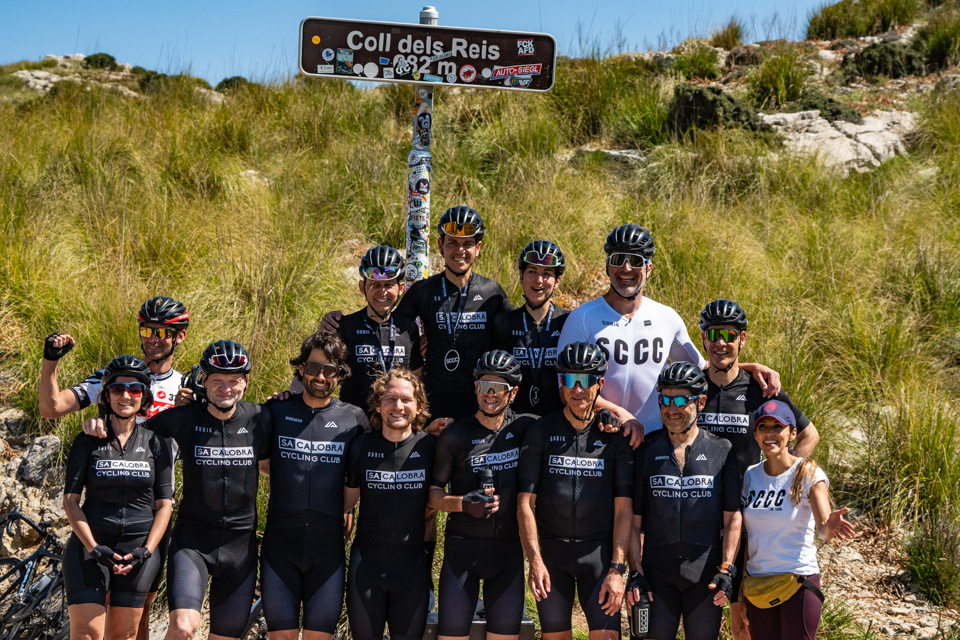
Not sure whether your level is suitable?
Send us your FTP, weight, weekly training volume and a couple of examples of your recent longest rides.
We will tell you directly whether we think you are ready for one of our camps and, if not, what we would recommend working on before joining us.
Ready for the challenge? View our upcoming Mallorca cycling camps and available dates.
Would you like to share your thoughts?
Leave a comment